GJ 3470 c: A Saturn-like Exoplanet Candidate in the Habitable Zone of GJ 3470

Phillip ScottBradley WalterQuanzhi YeDavid MitchellLeo HeilandXing GaoAlejandro PaladoBurkhonov OtabekJesus Delgado CasalColin HillAlberto GarciaKevin B. AltonYenal OgmenVikrant Kumar AgnihotriAlberto Caballero

We report the discovery of a new exoplanet candidate orbiting the star GJ 3470. A total of three transits were detected by OKSky Observatory: the first one on December 23, 2019, the second one on February 27, 2020, and the third one on May 3, 2020. We estimate an average transit depth of 0.84 percent and duration of 1 hour and 2 minutes. Based on this parameter, we calculate a radius of 9.2 Earth radii, which would correspond to the size of a Saturn-like exoplanet. We also estimate an orbital period of 66 days that places the exoplanet inside the habitable zone, near the orbital distance at Earths equivalent radiation. Another twelve potential transits that do not belong to GJ 3470 b are also reported. Despite our candidate for GJ 3470 c still has to be confirmed by the scientific community, the discovery represents a turning point in exoplanet research for being the first candidate discovered through an international project managed by amateur astronomers.

https://arxiv.org/abs/2007.07373

Submitted 14 July, 2020; originally announced July 2020.
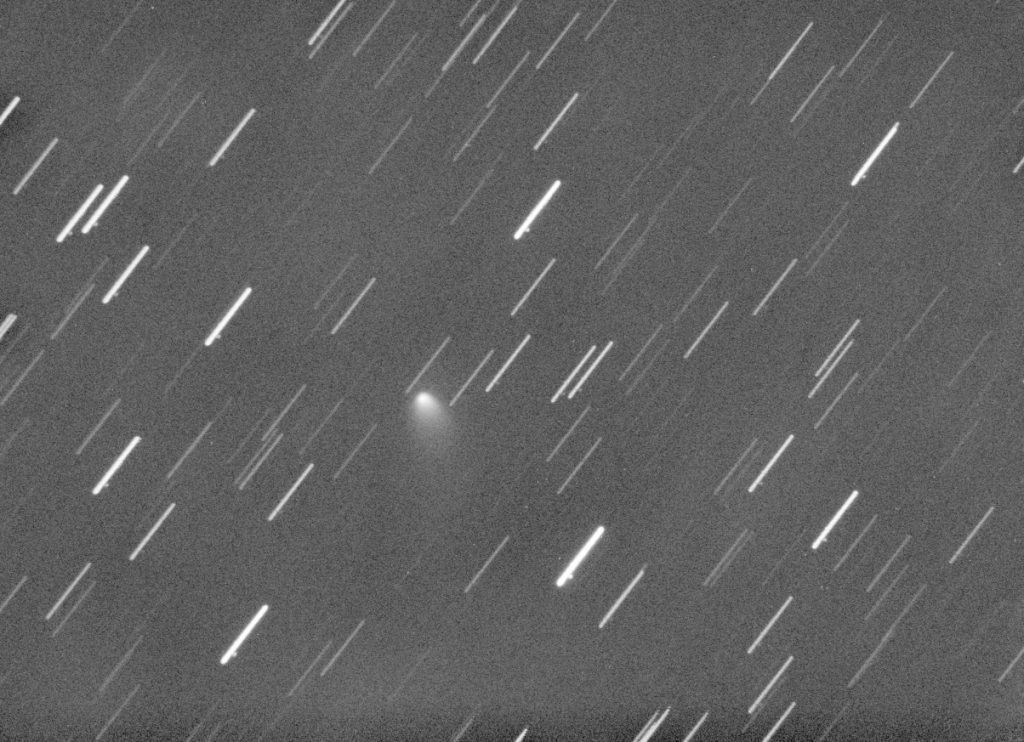
Comet 156P/Russell-LINEAR

Image:
Object: Comet 156P/Russell-LINEAR
DATE-OBS: 2020-12-31T14:17:27
EXPTIME: 3600.00 (seconds)
SUBFRMS: 30
OBJCTRA: 01 10 14.294
OBJCTDEC: +26 13 33.181
Instrument:
Catalog: UCAC4
Bessell (B): +*.*, Bessell (V): +*.*
Bessell (R): +13.7, Bessell (I): +*.*
CCD: ATIK-383L+
FILTERS: R
TELESCOPE: C11, 1623.0mm
PRiSMv10, Astrometrica
Site:
ORIGIN: Cepheid Observatory, India, Vorion Scientific, India
SITELAT: +24:55:00:00
SITELONG:+75:33:58:99
Observers:
V.K.Agnihotri, B. Kumar,
S. Mahawar, K.Vora
Remark:
NIL
End

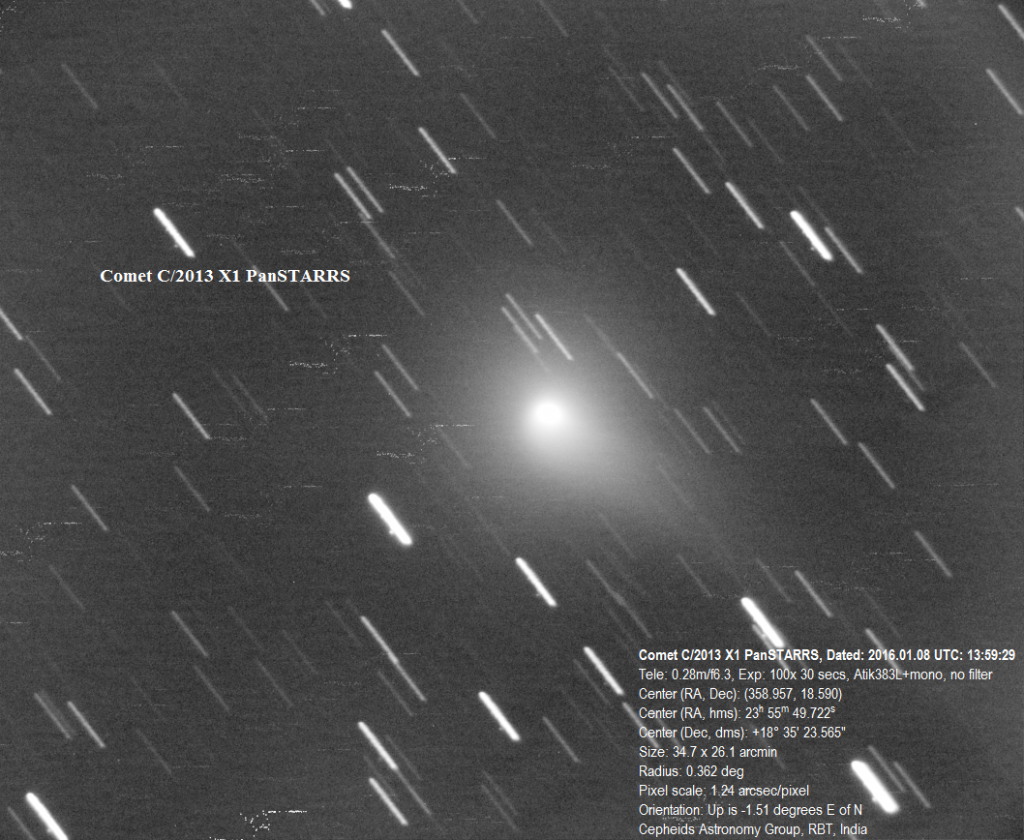
Comet C/2013 X1 PanSTARRS

Comet C/2013 X1 PanSTARRS, Dated: 2016.01.08 UTC: 13:59:29
Tele: 0.28m/f6.3, Exp: 100x 30 secs, Atik383L+mono, no filter
Center (RA, Dec): (358.957, 18.590)
Center (RA, hms): 23h 55m 49.722s
Center (Dec, dms): +18° 35′ 23.565″
Size: 34.7 x 26.1 arcmin
Radius: 0.362 deg
Pixel scale: 1.24 arcsec/pixel
Orientation: Up is -1.51 degrees E of N
Cepheids Astronomy Group, RBT, India 

C/2015 V2 Johnson

C/2015 V2 Johnson ‘2017-02-05T23:01:17’
Tele: C11/0.28m/f10.0, KAF8300 (3326X2504, 5.4µMX5.4µM)
Filter: XAF-GCE125 565rb (http://www.omegafilters.com/565rb.html)
Binning: 3X3 (16.21µmX16.21µm)
Tele field of view: 22.10acrminx16.66acrmin
Plate scale: 1.1859 arcsec/pix
Angle: 87.91 Deg
Exp: 9X90secs
Guiding: PHD2/ICX825
OBJCTRA: 15 43 37
OBJCTDEC: +44 49 15
APT Tool, Maximdl, CCDstack, DS9
Cepheids Astronomy Group,RBT, India. 

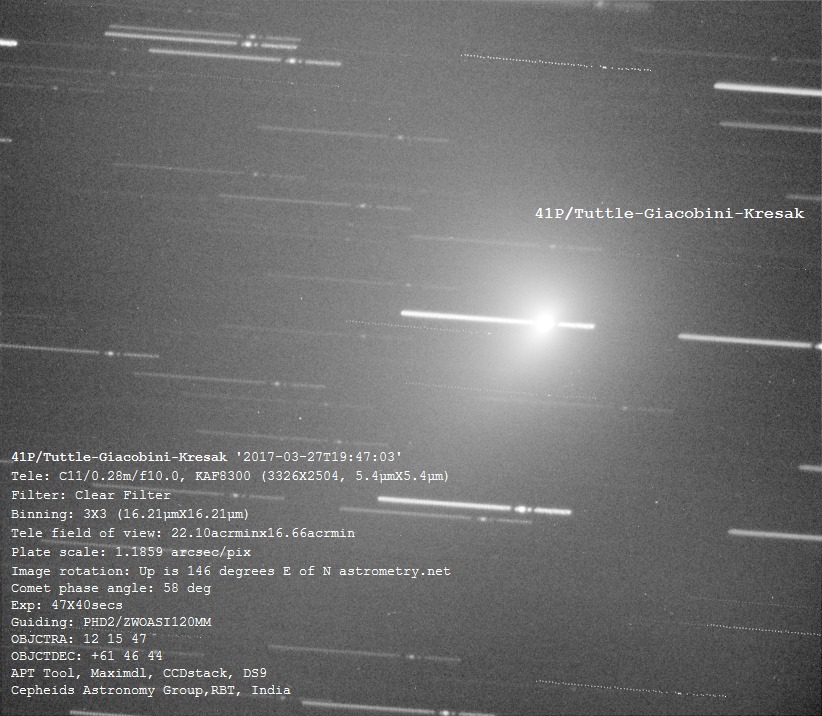
41P/Tuttle-Giacobini-Kresak

41P/Tuttle-Giacobini-Kresak ‘2017-03-27T19:47:03’
Tele: C11/0.28m/f10.0, KAF8300 (3326X2504, 5.4µmX5.4µm)
Filter: Clear Filter
Binning: 3X3 (16.21µmX16.21µm)
Tele field of view: 22.10acrminx16.66acrmin
Plate scale: 1.1859 arcsec/pix
Image rotation: Up is 146 degrees E of N astrometry.net
Comet phase angle: 58 deg
Exp: 47X40secs
Guiding: PHD2/ZWOASI120MM
OBJCTRA: 12 15 47
OBJCTDEC: +61 46 44
APT Tool, Maximdl, CCDstack, DS9
Cepheids Astronomy Group,RBT, India

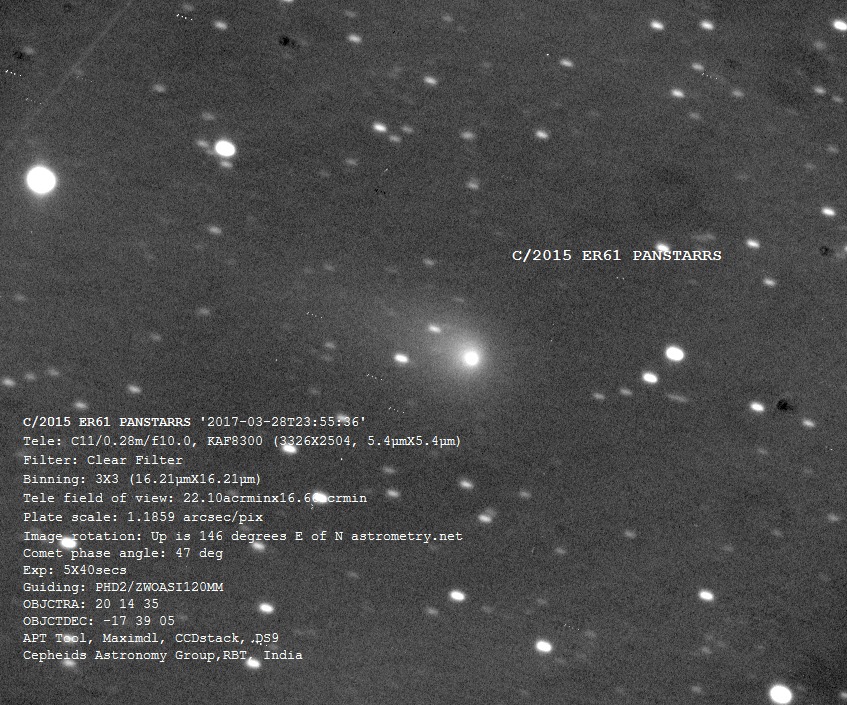
C/2015 ER61 PANSTARRS

C/2015 ER61 PANSTARRS ‘2017-03-28T23:55:36’
Tele: C11/0.28m/f10.0, KAF8300 (3326X2504, 5.4µmX5.4µm)
Filter: Clear Filter
Binning: 3X3 (16.21µmX16.21µm)
Tele field of view: 22.10acrminx16.66acrmin
Plate scale: 1.1859 arcsec/pix
Image rotation: Up is 146 degrees E of N astrometry.net
Comet phase angle: 47 deg
Exp: 5X40secs
Guiding: PHD2/ZWOASI120MM
OBJCTRA: 20 14 35
OBJCTDEC: -17 39 05
APT Tool, Maximdl, CCDstack, DS9
Cepheids Astronomy Group,RBT, India

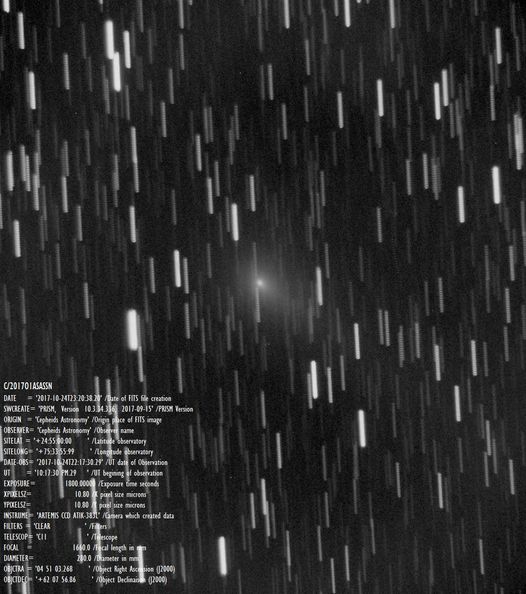
C/2017O1ASASSN

C/2017O1ASASSN
DATE = ‘2017-10-24T23:20:38.20’ /Date of FITS file creation
SWCREATE= ‘PRISM, Version 10.3.34.336, 2017-09-15’ /PRISM Version
ORIGIN = ‘Cepheids Astronomy’ /Origin place of FITS image
OBSERVER= ‘Cepheids Astronomy’ /Observer name
SITELAT = ‘+24:55:00:00 ‘ /Latitude observatory
SITELONG= ‘+75:33:55:99 ‘ /Longitude observatory
DATE-OBS= ‘2017-10-24T22:17:30.29’ /UT date of Observation
UT = ’10:17:30 PM.29 ‘ /UT begining of observation
EXPOSURE= 1800.00000 /Exposure time seconds
XPIXELSZ= 10.80 /X pixel size microns
YPIXELSZ= 10.80 /Y pixel size microns
INSTRUME= ‘ARTEMIS CCD ATIK-383L’ /Camera which created data
FILTERS = ‘CLEAR ‘ /Filters
TELESCOP= ‘C11 ‘ /Telescope
FOCAL = 1660.0 /Focal length in mm
DIAMETER= 280.0 /Diameter in mm
OBJCTRA = ’04 51 03.268 ‘ /Object Right Ascension (J2000)
OBJCTDEC= ‘+62 07 56.86 ‘ /Object Declinaison (J2000)

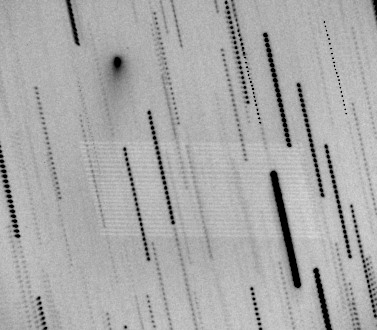
Comet C2017T1(Heinze)

Comet C2017T1(Heinze)
DATE = 2018-01-07T16:29:42.19 // Date of FITS file creation
SWCREATE= PRISM, Version 10.3.42.385, 2018-01-04 // Software Name and version
ORIGIN = Cepheids Astronomy // Origin place of FITS image
OBSERVER= Cepheids Astronomy // Observer name
SITELAT = +24:55:00:00 // Latitude observatory
SITELONG= +75:33:56:99 // Longitude observatory
UT = 03:14:17 PM.37 // UT begining of observation
EXPOSURE= 690.00000 // Exposure time seconds
XPIXELSZ= 12.90 // X pixel size microns
YPIXELSZ= 12.90 // Y pixel size microns
INSTRUME= ASCOM_ARTEMIS CCD: ATIK-414ex (247) // Camera which created data
TELESCOP= C11 // Telescope
FOCAL = 1447.0 // Focal length in mm
DIAMETER= 280.0 // Diameter in mm
OBJCTRA = 02 02 27.367 // Object Right Ascension (J2000)
OBJCTDEC= +68 10 02.99 // Object Declinaison (J2000)