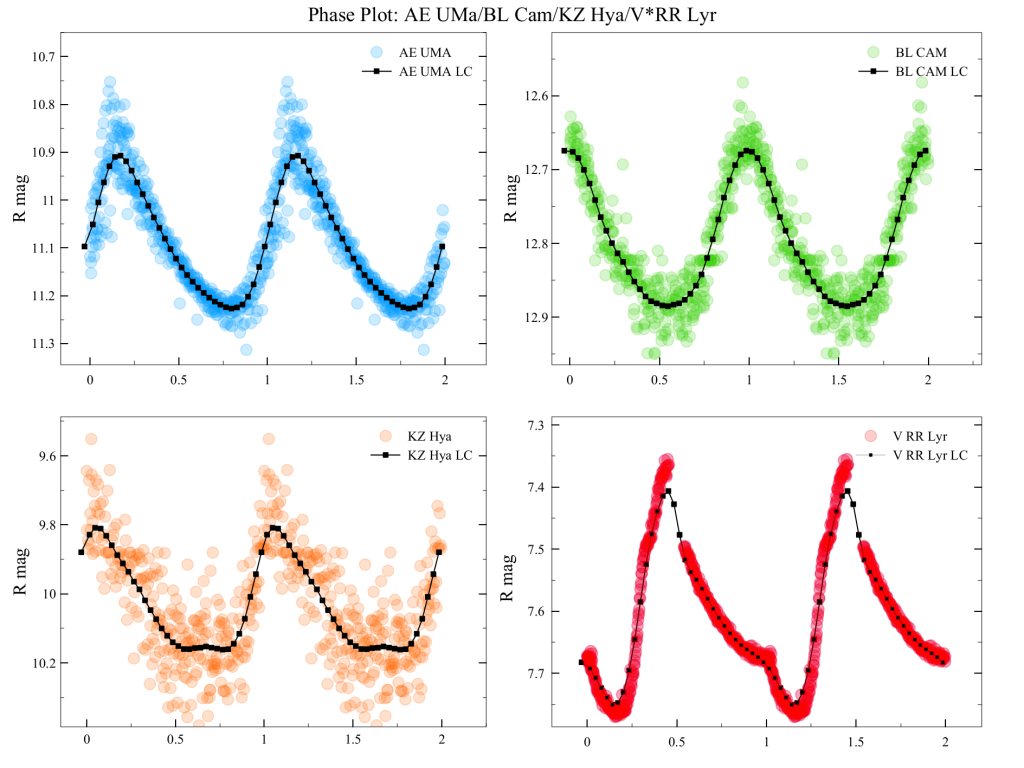
we did the ccd photometry of SX Phoenicis type of star BL Cam and AE. The data were collected for BL Cam (three days) and AE Uma (two days) using 132 mm APO at photometric R band from dates 14 Jan26 to 18Jan26.
SX Phoenicis variables are short-period pulsating variable stars characterized by pulsation periods ranging from approximately 0.03 to 0.09 days. They are spectral class of A2 to F5, with effective temperatures around 7500 K, and are distinguished by their low metallicity and position in the instability strip of the Hertzsprung-Russell diagram, near or on the zero-age main sequence.
SX Phoenicis variables are the metal-poor, lower-luminosity and shows the period luminosity relation.
The images were photometrically reduced in data sets using Tycho and ATLAS catalogue. The light curves were analysed using Peranso (Fourier Analysis of Light Curves, Harris).
The spectral frequency domain shows the periods of BL Cam and AE UMa 0.039097 days and 0.086037 days respectively.
RR Lyrae variables are old, low-mass, radially pulsating stars with periods in the range between 0.2 and 1 day. They are a numerous class of variable stars that populate galactic halos, thick disks and globular clusters. In the H-R diagram, RR Lyrae stars can be found in the narrow region where the horizontal branch intersects the pulsational instability strip. Their relatively small range of absolute mean magnitudes (because they lie on the horizontal branch) makes them important distance indicators in both our own Galaxy and those nearby. RR Lyrae stars are also excellent tracers of the chemical and dynamical properties of the oldest observable population of stars, so they give us insight into the earliest history of galaxies. Taking into account the pulsation modes, RR Lyrae stars can be divided into fundamental-mode (commonly referred to as RRab stars, sometimes called RR0 stars), first-overtone (RRc or RR1 stars) and double-mode (RRd or RR01 stars) pulsators. The existence of second-overtone pulsators among RR Lyrae variables (RRe or RR2 stars) is a matter of controversy. https://ogle.astrouw.edu.pl/atlas/RR_Lyr.html
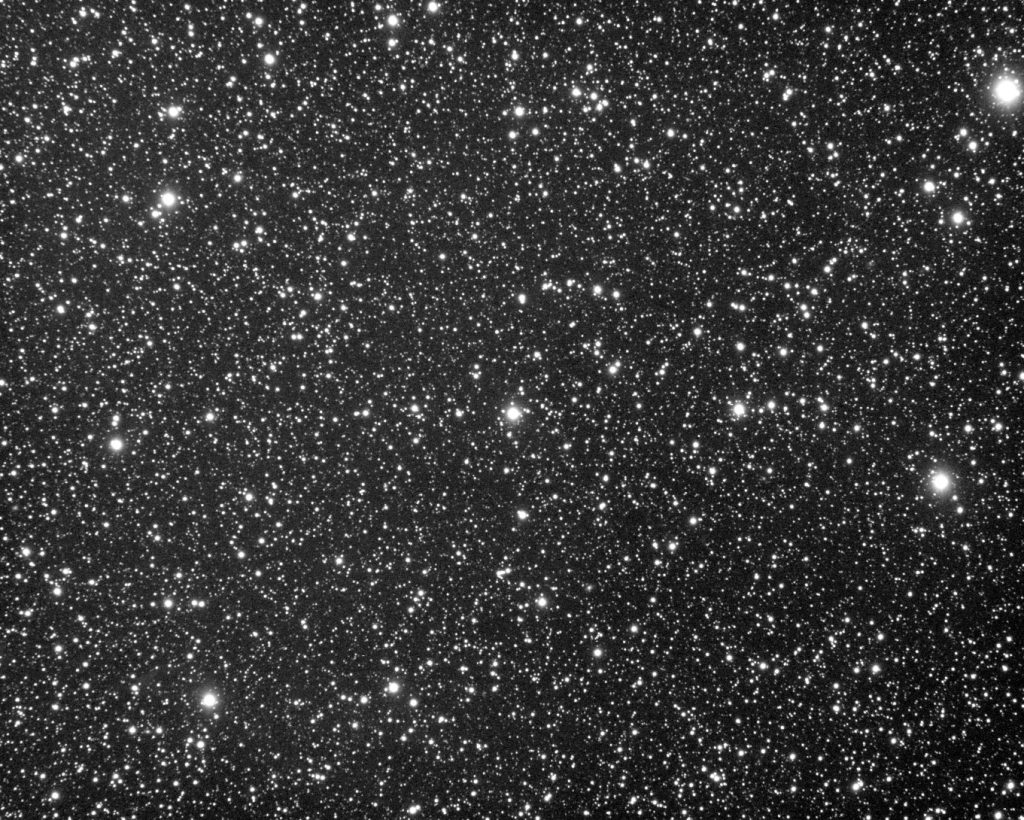
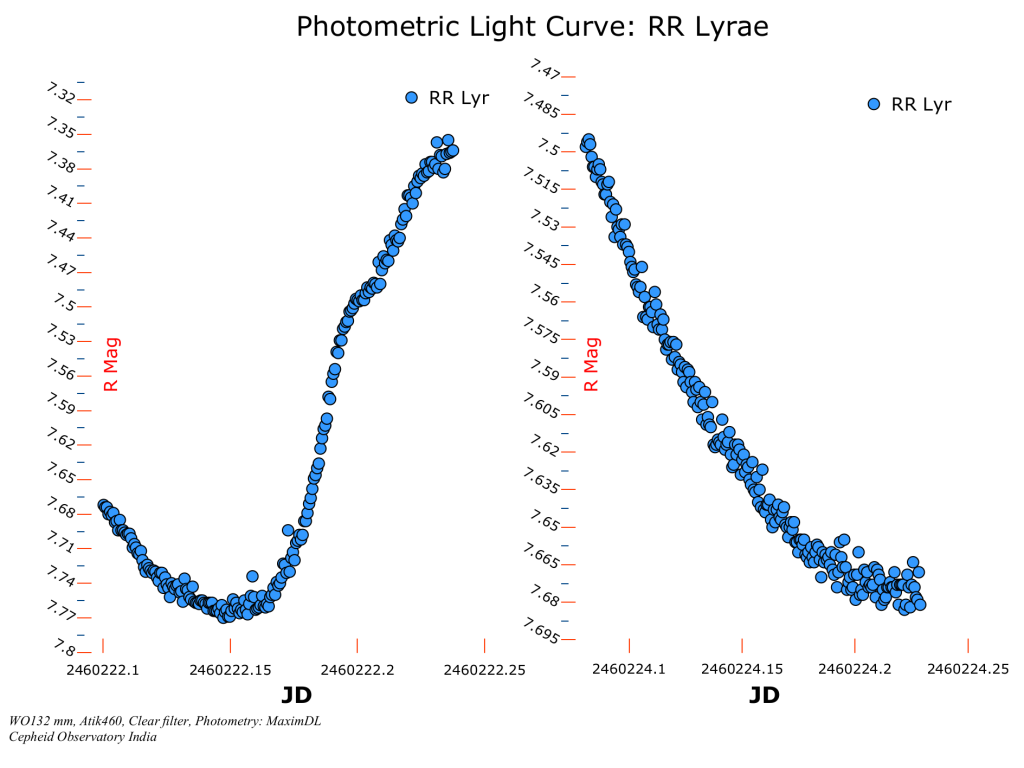
Object: RR Lyrae DATE-OBS: 2023-10-04T14:24:04.5960 + 2 Days EXPTIME(Hrs): 5.64 SUBFRMS: 451 OBJCTRA: 19 25 27.872 OBJCTDEC: +42 46 59.05 Binning: 1 X 1 Plate Scale: 1.53″ /Pixel Orientation: North UP/ East Left Catalogs & Filter Magnitude Results: Astrometry Catalog: ATLAS Photometry Catalog: ATLAS Imaging Filter: CLEAR Photometry Mag: +7.6 R Instruments: CCD: ICX694M (4.5µm x 4.5µm) TELESCOPE: 132MM APO, 610mm PRiSMv11, Tycho10.8.4, Maxim DL Site: ORIGIN: Cepheid Observatory, India SITELAT: +24:55:00:00 SITELONG:+75:33:58:99 Observers: Cepheid Observatory Remark: Sky Clear
Note: The observations is done partially for 3 days, as object was visible for few hours in every night. The RR Lyrae have period of 0.56689 days and some of portions of possible maxima and minima covered. The exercise is done for learning and interest. https://browse.arxiv.org/pdf/astro-ph/0601432.pdf