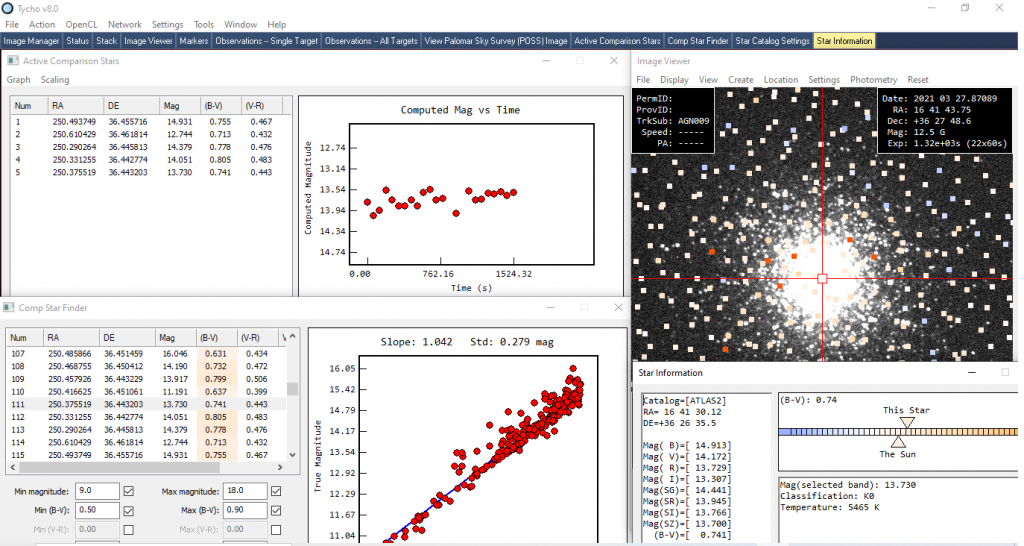
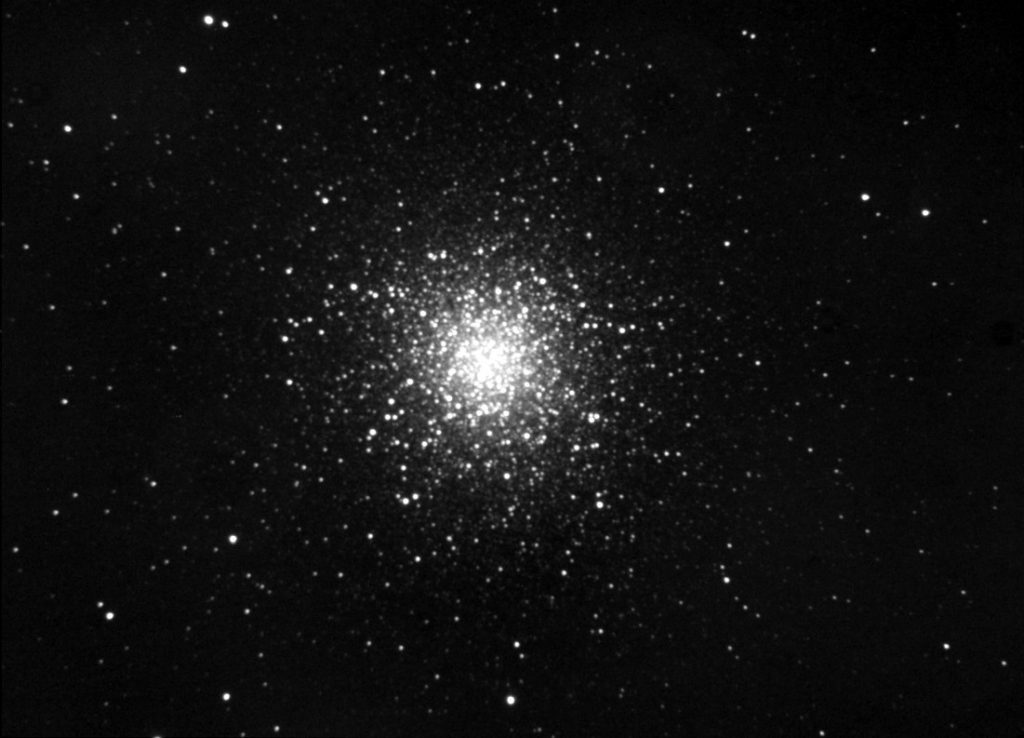
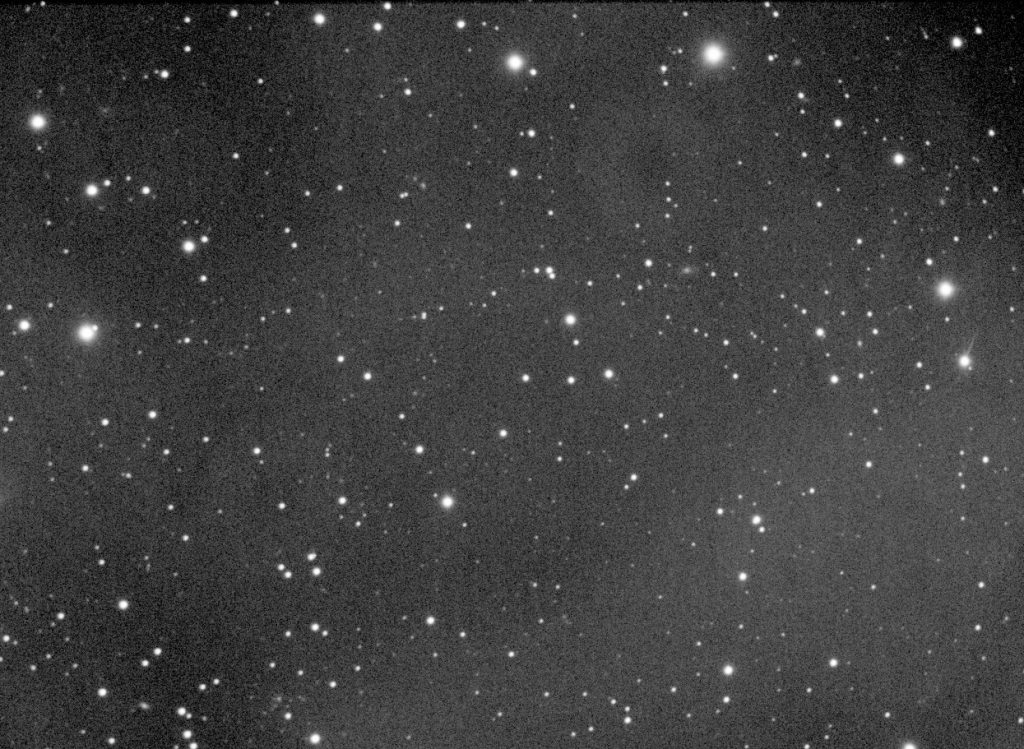
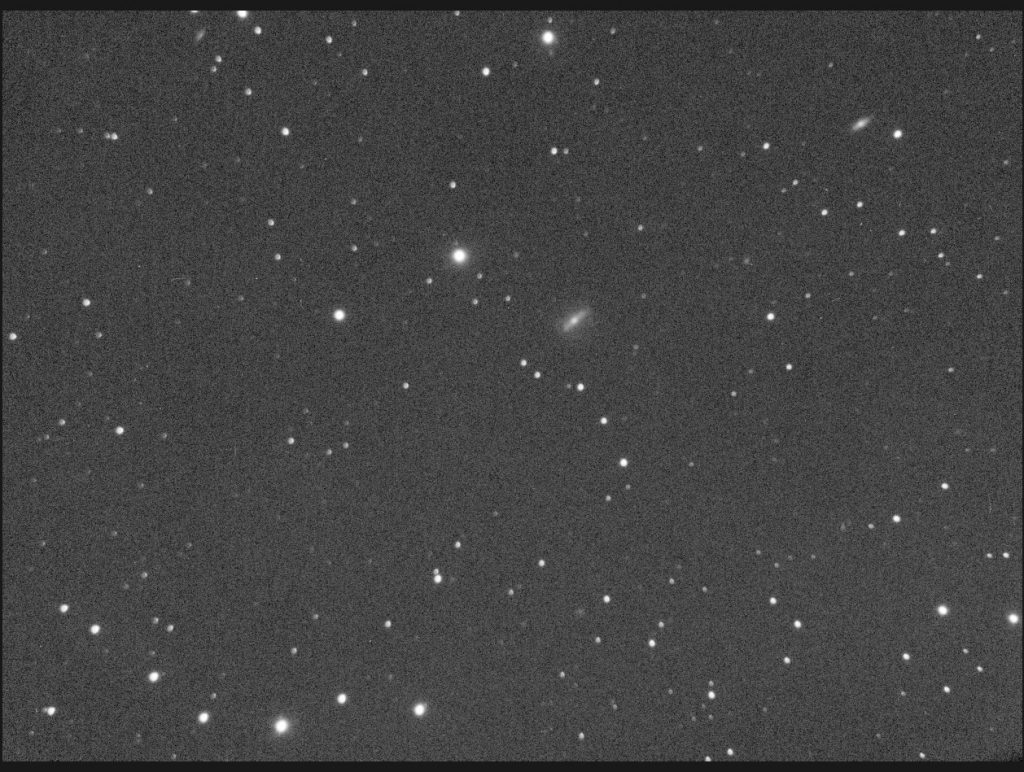
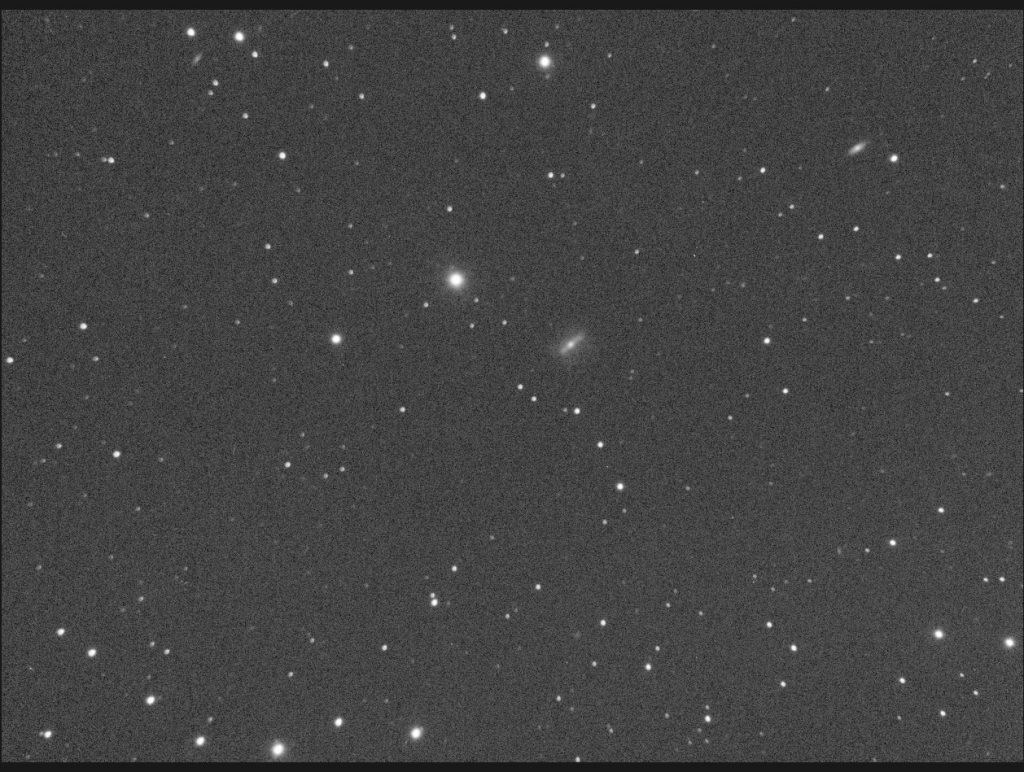
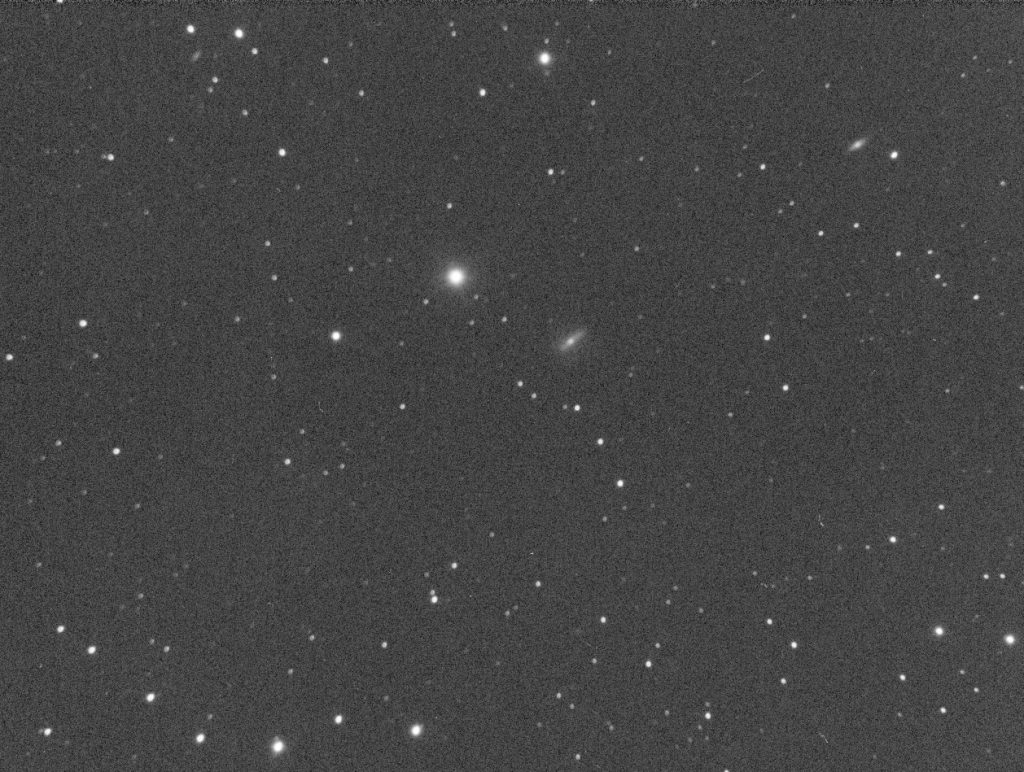
We examine the astrometry and photometry of globular star cluster M13 using Gaia EDR3 and ATLAS catalogs. The Gaia EDR3 catalog is for astrometry and ATLAS catalog is for high precession differential photometry. The software Tycho 8.0 supports both the catalogs upto +22.0 magnitudes. If stars are well resolved (imaged at higher focal length), the results will be promising.
Image: Object: M13 DATE-OBS: 2021-03-27T20:56:25.69 EXPTIME: 1320.00 (seconds) SUBFRMS: 22 OBJCTRA: 16 41 46.016 OBJCTDEC: +36 27 13.50 Instrument: Catalog: Gaia EDR3 + ATLAS Bessell (B): +*.*, Bessell (V): +*.* Bessell (R): +*.*, Bessell (I): +*.* CCD: ATIK-383L+ FILTERS: R TELESCOPE: C11, 1623.0mm PRiSMv10, Tycho Site: ORIGIN: Cepheid Observatory, India, Vorion Scientific, India SITELAT: +24:55:00:00 SITELONG:+75:33:58:99 Observers: V.K.Agnihotri, B. Kumar, S. Mahawar, K.Vora Remark: High Moon, Sky Clear. End
The offline variant, “GRAPPA”, was developed by Marc Serrau. Please also include the following acknowledgements if using the catalog in a published paper:
Acknowledgements:
Marc Serrau
ESA GAIA Mission as GRAPPA3 has made use of data from the European Space Agency (ESA) mission Gaia (https://www.cosmos.esa.int/gaia), processed by the Gaia Data Processing and Analysis Consortium (DPAC, https://www.cosmos.esa.int/web/gaia/dpac/consortium).
The acknowledgements for ALTAS catalog, to be used when publishing a paper, are as follows: This work has made use of data from the Asteroid Terrestrial-impact Last Alert System (ATLAS) project. ATLAS is primarily funded to search for near earth asteroids through NASA grants NN12AR55G, 80NSSC18K0284, and 80NSSC18K1575; byproducts of the NEO search include images and catalogs from the survey area. The ATLAS science products have been made possible through the contributions of the University of Hawaii Institute for Astronomy, the Queen’s University Belfast, the Space Telescope Science Institute, and the South African Astronomical Observatory.
References: Tonry, J.L., Denneau, L., Flewelling, H., Heinze, A.N., Onken, C.A., Smartt, S.J., Stalder, B., Weiland, H.J., Wolf, C. (2018). “The ATLAS All-Sky Stellar Reference Catalog.” Astrophys. J. 867, A105. Kostov, A., Bonev, T. (2017). “Transformation of Pan-STARRS1 gri to Stetson BVRI magnitudes. Photometry of small bodies observations.” Bulgarian Astron. J. 28, 3 (AriXiv:1706.06147v2).
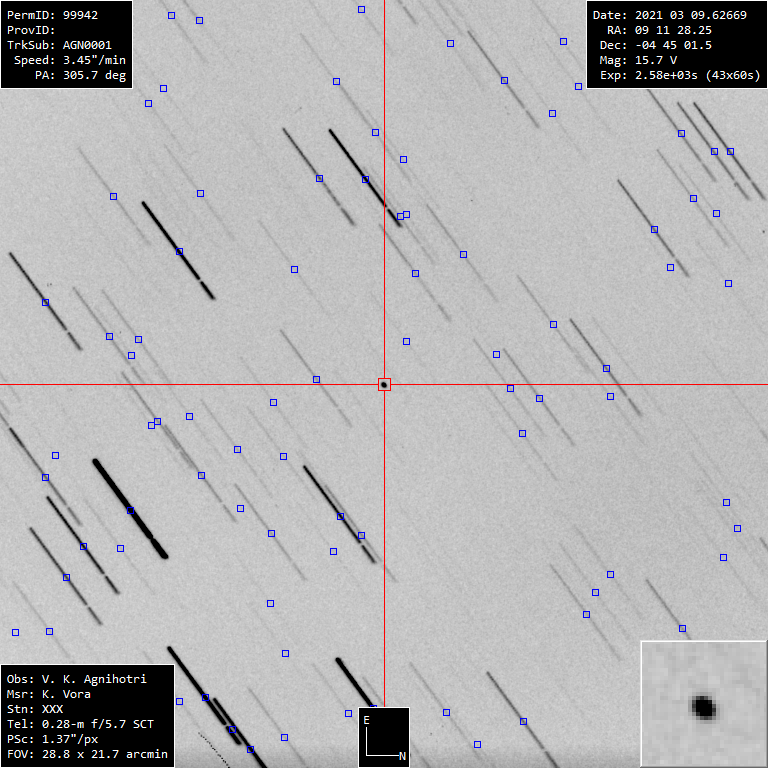
Asteroid photometry is nothing but the study of fraction of solar radiation, which is reflected by the surface of small body. Here we examined the photometry of Apophis, a big/elongate metal rich asteroid passing by near to earth.
If we assume that asteroid Apophis is metal rich, it could reflect good part of solar radiation at V band as well as R Band. The tendency of photon reflection decrease from V (short wavelengths) to R (longer wavelengths) band. Here we took the assumption that sun is G2V type star, so most of photons are towards yellow + red end and hence small body is reflecting more photons at R band. These are just assumption to make task interesting. Anyway!
The second point is that if asteroid is perfect spherical body, spinning around random axis will reflect same flux towards telescope, but case will be different if small body have irregular structure. In this case the flux reflected will be proportional to the cosine of area seen by telescope and depend on angle between sun/asteroid/earth.
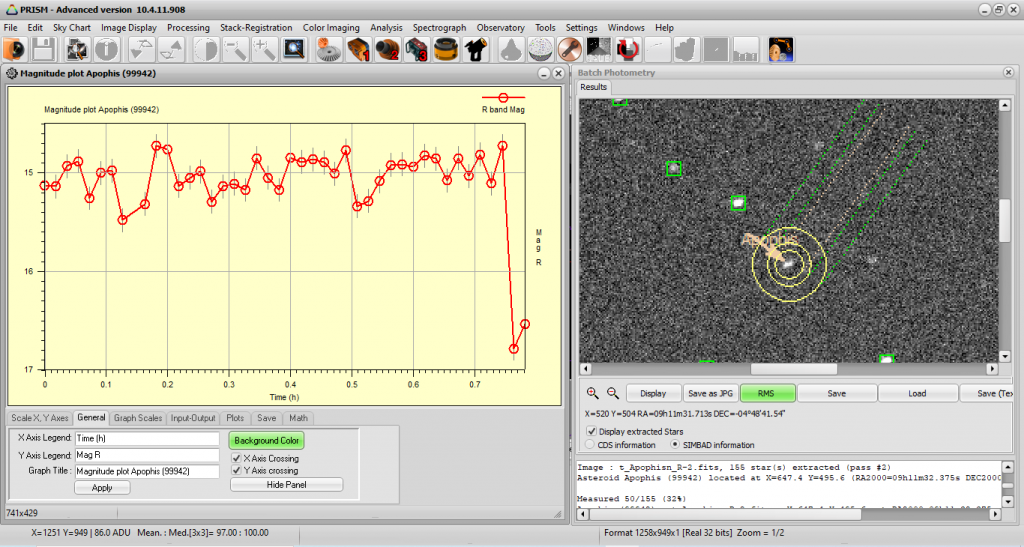
In our study, we dragged the R band flux w.r.t time. The FITS generated and examined using PriSMv10 batch photometry using UCAC4 catalog. The results are shown below.
Apophis Photometric Curve
We should not forget that Apophis photometric curve was measured w.r.t standard stars and as soon as sun and asteroid changes the position in sky, the incident solar flux does not remain constant. It can be seen that the magnitude at the end of observation goes too high.
Instrument: Catalog: UCAC4 Bessell (B): +*.*, Bessell (V): +*.* Bessell (R): +15.2, Bessell (I): +*.* CCD: ATIK-383L+ FILTERS: R TELESCOPE: C11, 1623.0mm PRiSMv10, Astrometrica Site: ORIGIN: Cepheid Observatory, India, Vorion Scientific, India SITELAT: +24:55:00:00 SITELONG:+75:33:58:99 Observers: V.K.Agnihotri, B. Kumar, S. Mahawar, K.Vora Remark: Sky Clear. End
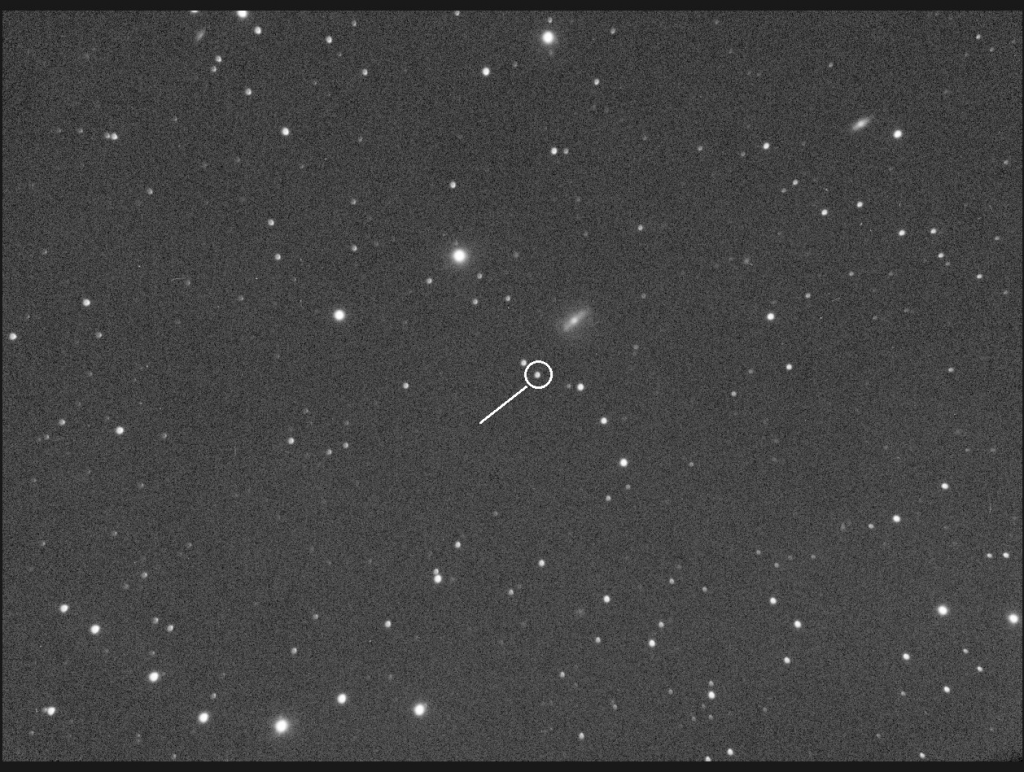
Image: Object: TCP J09370380+1657350 DATE-OBS: 2021-01-13T20:16:18 EXPTIME: 1200.0 (seconds) for V/R/I SUBFRMS: 10 OBJCTRA: 09 37 03.80 OBJCTDEC: +16 57 35.00 Instrument: Catalog: UCAC4/USNOB1 Bessell (B): +*.*, Bessell (V): +14.614 Bessell (R): +14.848, Bessell (I): +14.734 CCD: ATIK-383L+ FILTERS: V/R/I TELESCOPE: C11, 1623.0mm PRiSMv10, Astrometrica Site: ORIGIN: Cepheid Observatory, India, Vorion Scientific, India SITELAT: +24:55:00:00 SITELONG:+75:33:58:99 Observers: K.Vora, V.K.Agnihotri, B. Kumar, S. Mahawar, Remark: Sky Clear. V and R band magnitudes are estimated using UCAC4 catalog. I band magnitude is estimated using USNOB1 catalog. End
V band JD 2459228.35160R band JD 2459228.32211I Band JD 2459228.33774
Sample Marked Image
TCP J09370380+1657350 Circled
JD mag Flt SNR ZeroPt Cat Design.
2459228.32211 14.848 R R 136.93 27.223 UCAC4 TCP 2459228.33774 14.734 I I 73.31 26.073 USNOB1 TCP 2459228.35160 14.614 V V 242.13 27.536 UCAC4 TCP —– end —–
M67/NGC2682 image using B & R band filters. The exposure time normalized for CCD sensitivity (means more exposure in B band w.r.t band). We see the more stars in R Band compare to B band.