Photometry and Period estimation of SX Phoenicis type of star: BL Cam and AE UMa

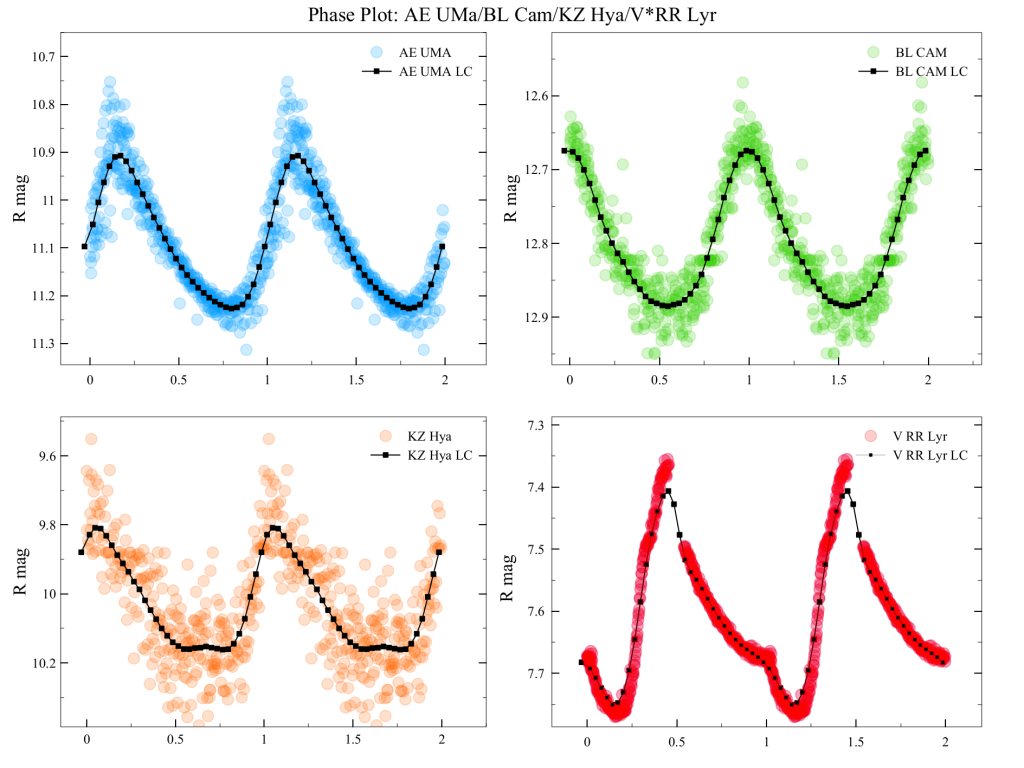
we did the ccd photometry of SX Phoenicis type of star BL Cam and AE. The data were collected for BL Cam (three days) and AE Uma (two days) using 132 mm APO at photometric R band from dates 14 Jan26 to 18Jan26.

SX Phoenicis variables are short-period pulsating variable stars characterized by pulsation periods ranging from approximately 0.03 to 0.09 days.  They are spectral class of A2 to F5, with effective temperatures around 7500 K, and are distinguished by their low metallicity and position in the instability strip of the Hertzsprung-Russell diagram, near or on the zero-age main sequence.

SX Phoenicis variables are the metal-poor, lower-luminosity and shows the period luminosity relation.

The images were photometrically reduced in data sets using Tycho and ATLAS catalogue. The light curves were analysed using Peranso (Fourier Analysis of Light Curves, Harris).

The spectral frequency domain shows the periods of BL Cam and AE UMa 0.039097 days and 0.086037 days respectively.
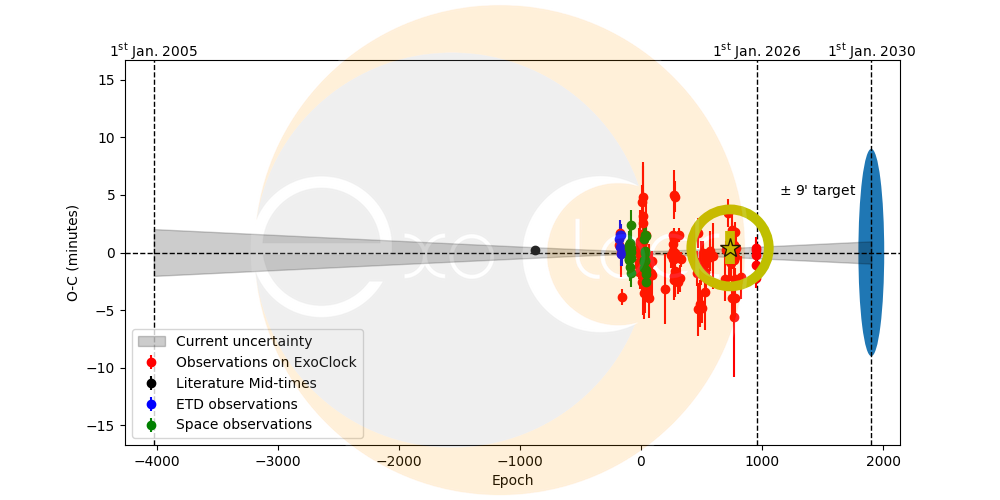
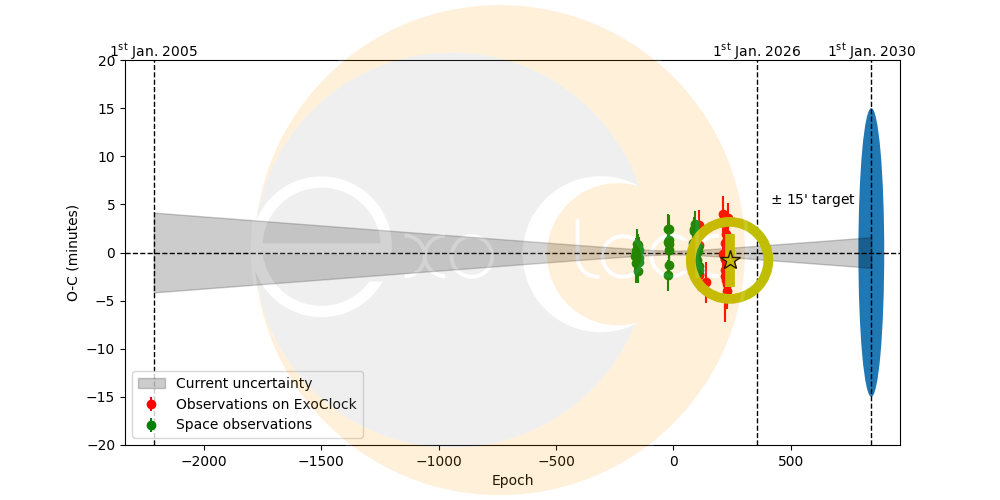
ExoClock Project IV: A homogeneous catalogue of 620 updated exoplanet ephemerides

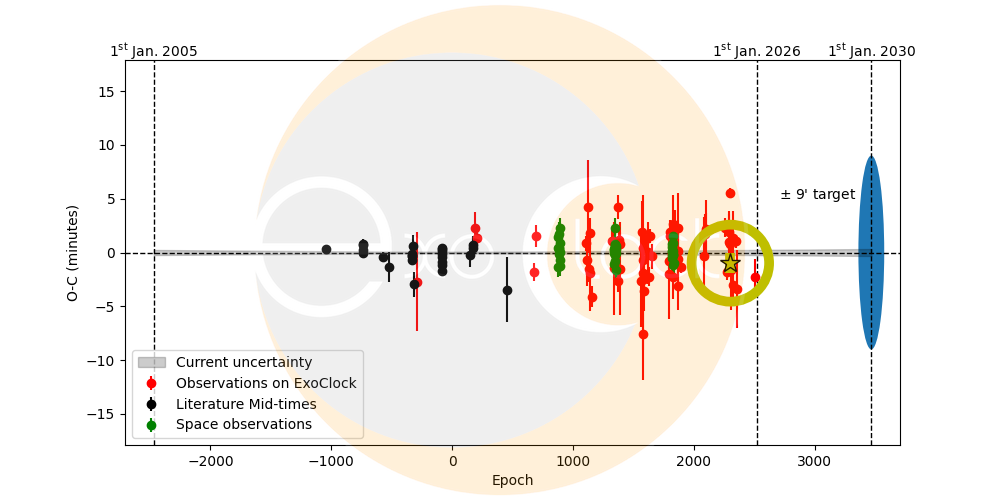
The ExoClock project is an open platform aiming to monitor exoplanets by integrating observations from space and ground based telescopes. This study presents an updated catalogue of 620 exoplanet ephemerides, integrating 30000 measurements from ground-based telescopes (the ExoClock network), literature, and space telescopes (Kepler, K2 and TESS). The updated catalogue includes 277 planets from TESS which require special observing strategies due to their shallow transits or bright host stars. This study demonstrates that data from larger telescopes and the employment of new methodologies such as synchronous observations with small telescopes, are capable of monitoring special cases of planets. The new ephemerides show that 45% of the planets required an update while the results show an improvement of one order of magnitude in prediction uncertainty. The collective analysis also enabled the identification of new planets showing TTVs, highlighting the importance of extensive observing coverage. Developed in the context of the ESA’s Ariel space mission, with the goal of delivering a catalogue with reliable ephemerides to increase the mission efficiency, ExoClock’s scope and service have grown well beyond the remit of Ariel. The ExoClock project has been operating in the framework of open science, and all tools and products are accessible to everyone within academia and beyond, to support efficient scheduling of future exoplanet observations, especially from larger telescopes where the pressure for time allocation efficiency is higher (Ariel, JWST, VLT, ELT, Subaru etc). The inclusion of diverse audiences in the process and the collaborative mode not only foster democratisation of science but also enhance the quality of the results.

https://doi.org/10.48550/arXiv.2511.14407

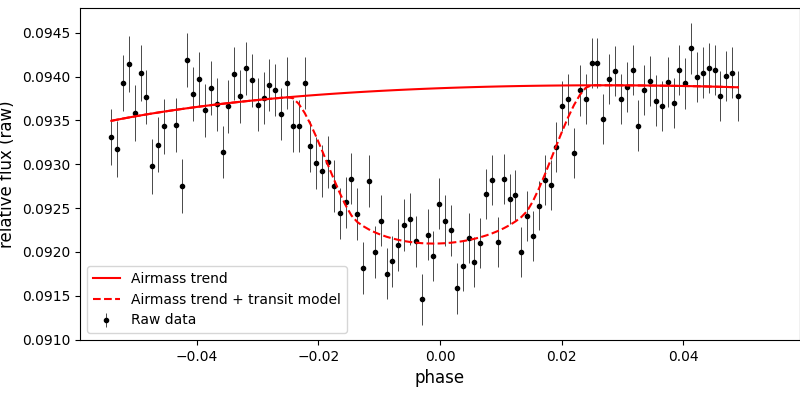
Photometry: WASP-36b

Exo-Planet, Class confirmed:
WASP-36b
Imaged/Calibration/Image solve:
PRiSM v11
Photometry and Data Fitting:
HOPS 3.1.2/Platform: Python 3.12 Anaconda Package
Instrument:
CCD: SX35 (KAF11001M)
FILTERS: Luminance
TELESCOPE: RC14, 1877.0 mm
Site:
ORIGIN: Cepheid Observatory India
SITELAT: +24:55:00:00
SITELONG:+75:33:58:99
Observer:
Cepheid Observatory India
Remark:
Sky Clear
Results
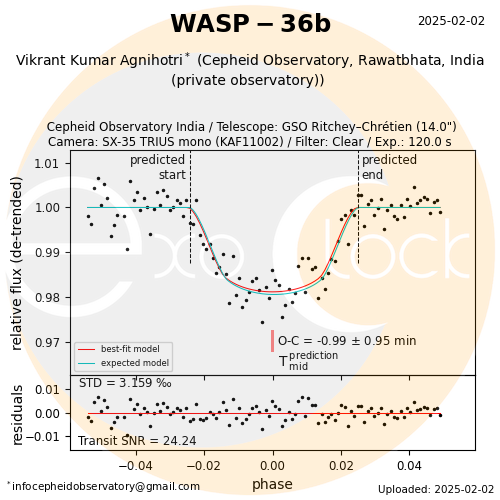
Rp/Rs = 0.1347 ± 0.0028 (expected: 0.1368 ± 0.0006)
O-C = -0.99 ± 0.95 minutes

Diagnostics
Transit SNR = 24.24 (good:≥5, acceptable:≥3)
(strong detection of the transit)
Rp/Rs drift = -0.73σ (good:≤2, acceptable:≤3)
(Rp/Rs in good agreement with the literature)
AutoCorrelation = 0.271 (good:≤0.301, acceptable:≤0.367)
(no systematics in the data)
Shapiro = 0.007 (good:≤0.028, acceptable:≤0.046)
(few or no outliers in the data)

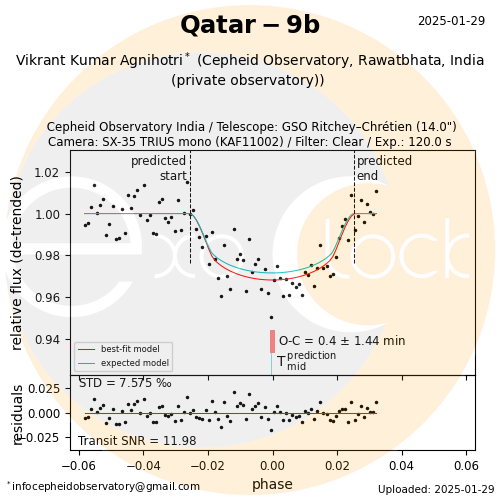
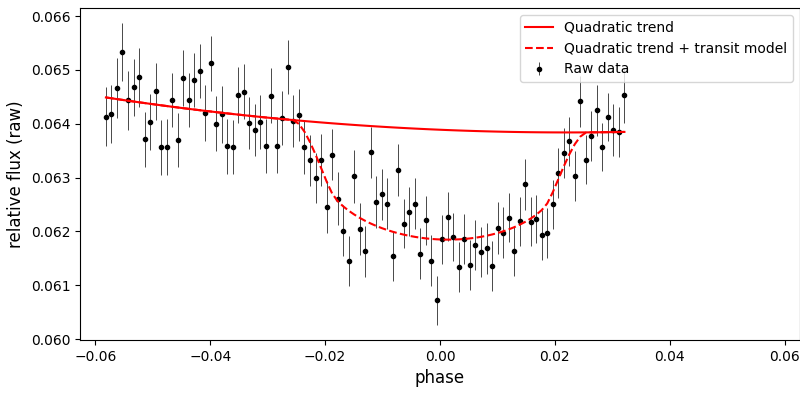
Photometry: Qatar-9b

Exo-Planet, Class confirmed:
Qatar-9b
Imaged/Calibration/Image solve:
PRiSM v11
Photometry and Data Fitting:
HOPS 3.1.2/Platform: Python 3.12 Anaconda Package
Instrument:
CCD: SX35 (KAF11001M)
FILTERS: Luminance
TELESCOPE: RC14, 1877.0 mm
Site:
ORIGIN: Cepheid Observatory India
SITELAT: +24:55:00:00
SITELONG:+75:33:58:99
Observer:
Cepheid Observatory India
Remark:
Sky Clear
Results
Rp/Rs = 0.1575 ± 0.0066 (expected: 0.1489 ± 0.0009)
O-C = 0.4 ± 1.44 minutes

Diagnostics
Transit SNR = 11.98 (good:≥5, acceptable:≥3)
(strong detection of the transit)
Rp/Rs drift = 1.29σ (good:≤2, acceptable:≤3)
(Rp/Rs in good agreement with the literature)
AutoCorrelation = 0.203 (good:≤0.315, acceptable:≤0.385)
(no systematics in the data)
Shapiro = 0.013 (good:≤0.032, acceptable:≤0.052)
(few or no outliers in the data)

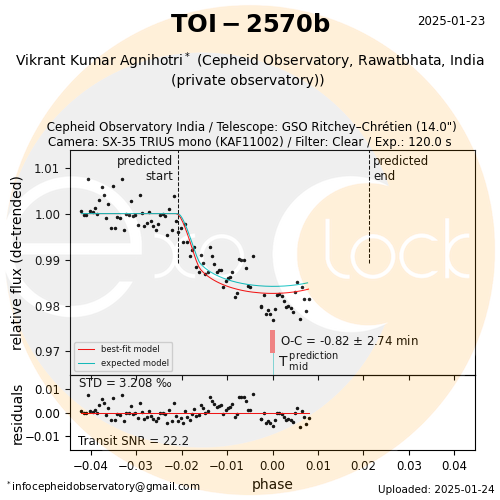
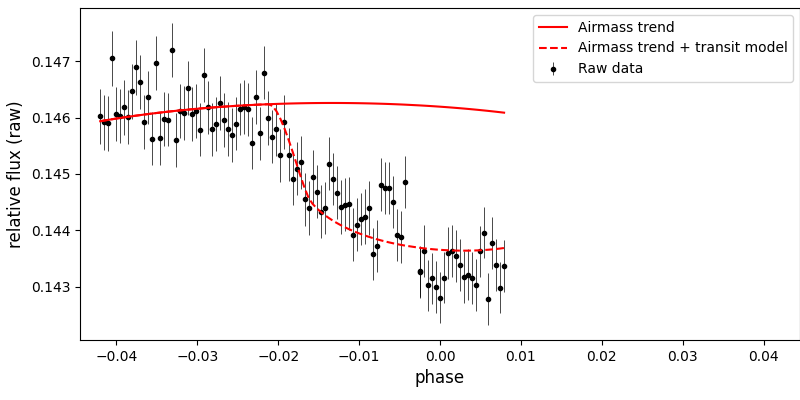
Photometry: TOI-2570b

Exo-Planet, Class confirmed:
TOI-2570b
Imaged/Calibration/Image solve:
PRiSM v11
Photometry and Data Fitting:
HOPS 3.1.2/Platform: Python 3.12 Anaconda Package
Instrument:
CCD: SX35 (KAF11001M)
FILTERS: Luminance
TELESCOPE: RC14, 1877.0 mm
Site:
ORIGIN: Cepheid Observatory India
SITELAT: +24:55:00:00
SITELONG:+75:33:58:99
Observer:
Cepheid Observatory India
Remark:
Sky Clear
Results
Rp/Rs = 0.1196 ± 0.0027 (expected: 0.11419 ± 0.001138)
O-C = -0.82 ± 2.74 minutes

Diagnostics
Transit SNR = 22.2 (good:≥5, acceptable:≥3)
(strong detection of the transit)
Rp/Rs drift = 1.85σ (good:≤2, acceptable:≤3)
(Rp/Rs in good agreement with the literature)
AutoCorrelation = 0.349 (good:≤0.309, acceptable:≤0.377)
(weak systematics in the data)
Shapiro = 0.035 (good:≤0.03, acceptable:≤0.05)
(some outliers in the data)